
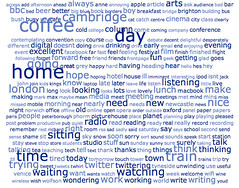
Tweetcloud takes all your public tweet and makes a tag cloud out of them. It’s far too accurate… home, coffee, cambridge, sitting, watching, train, time…
Who Will Write Tomorrow’s Code?
[As ever, this is available on the BBC News website]
On Monday 31st March I was at Queens’ College, Cambridge, for the dinner to celebrate the 70th anniversary of the formation of the Mathematical Laboratory, which later became the Computer Laboratory.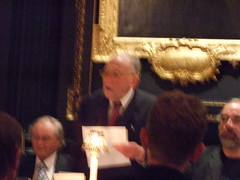 Maurice Wilkes, who build the EDSAC in 1949, was there, and gave a speech. And the conversation on my table was largely about the problems of finding good programmers and of persuading young people that Computer Science is a good degree to do. This article was the result.
Sixty years ago, on June 21 1948, the Small-Scale Experimental Machine, or ‘Baby’, ran its first program and the age of the stored program digital computer properly began.
Built by a team led by Tom Kilburn and Freddie Williams at Manchester University, Baby showed that storing the instructions for a computer in the same memory as the data it was working on was both feasible and effective.
Lunch at Les Deux Magots
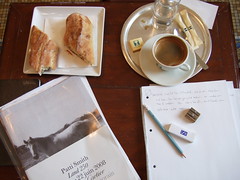
I went to Paris yesterday to see the Patti Smith exhibition, Land 250, at the Fondation Cartier. It was fabulous, a thrilling insight into the mind and work of someone I have admired for many years.
And afterwards I sat on the bench where de Beauvoir and Sartre worked, in Les Deux Magot, for a coffee and a baguette.
Denial of Democracy Attacks
[As ever you can read this on the BBC News website]
In common with other administrations the UK Government is concerned about the security of the realm and its ability to cope with natural disasters, foreign aggression and terrorism.
Over the years the importance of computer systems, networks and of course the internet have become apparent even at the highest level of the administration, so it is unsurprising that the National Security Strategy announced by the Prime Minister last week contains a number of references to the network and to the growing fear of what they call ‘cyber-attack’.
The strategy notes that ‘the internet is itself a trans-national, fast-changing and loosely-governed entity, but is also part of our critical national infrastructure’ before stating the obvious by pointing out that ‘it is both a target and an opportunity for hostile states, terrorists and criminals’. (p21)
Just like EastEnders
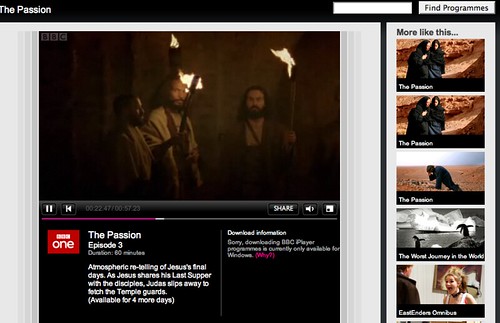
Watching ‘The Passion’ on BBC iPlayer I was rather intrigued by the programmes suggested by the ‘More Like This’ feature… ‘The Worst Journey in the World’ makes some bizarre sense – but EastEnders?
The Offline Cost of an Online Life
[As ever, you can read this on the BBC News website]
The next time you want to search for something on the web, try going to ‘www.blackle.com’ instead of your usual search engine.
The page you get looks remarkably like Google, and queries you type in are fed through to Google, but there’s one obvious difference. Instead of the generous amount of white space which has characterised Google’s home page since its 1998 launch, the page is mostly black.
Heap Media, the Australian company behind Blackle, claim that black pixels take less power than white and so using their search saves energy. They believe that small things matter when it comes to reducing our energy use, limiting our C02 output and reducing the likely extent of global warming as a result of human activity.
My del.icio.us bookmarks for March 15th through March 16th
Here’s what I tagged on del.icio.us between March 15th and March 16th:
- TweetStats :: for billt – my twitter usage
- My review of the new Michio Kaku book
My del.icio.us bookmarks for March 14th through March 15th
Here’s what I tagged on del.icio.us between March 14th and March 15th:
I saw this…
Here’s what I’ve tagged on del.icio.us on %date%:
I saw this…
Here’s what I’ve tagged on del.icio.us on %date%: